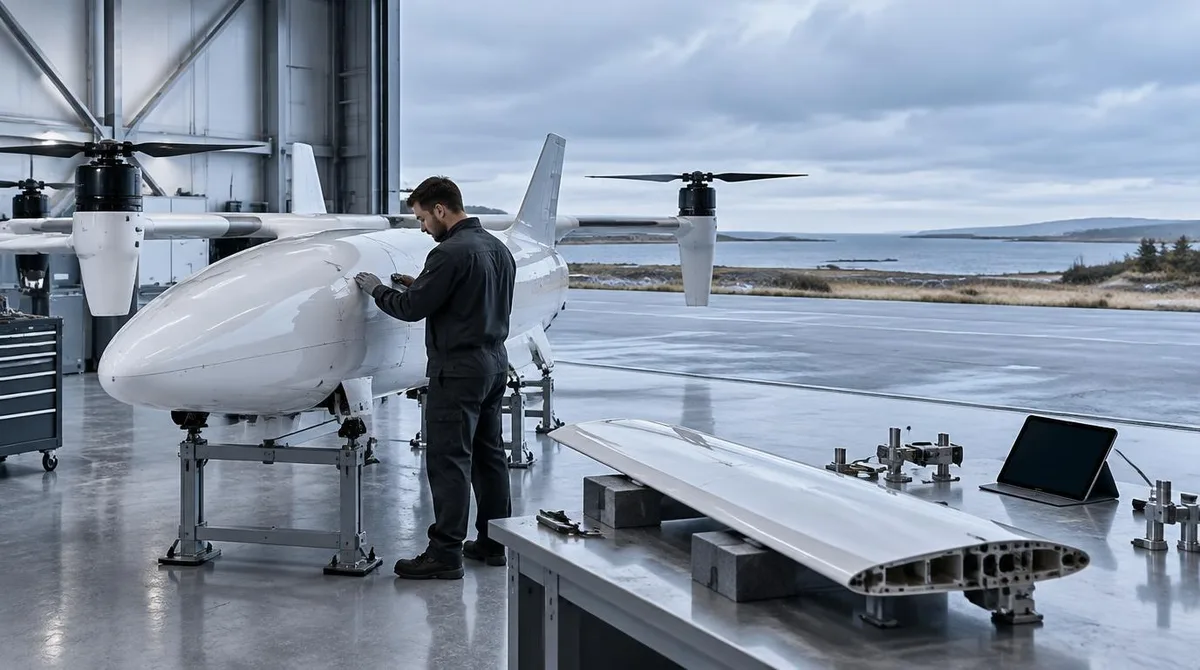
Israeli drone maker Aeronautics has signed an agreement with an Airbus unit to produce its Orbiter 4 in Germany. Under the deal with Airbus DS Airborne Solutions (ADAS), the company would build its Orbiter 4 vertical-takeoff-and-landing (VTOL) uncrewed aircraft system locally and transfer production know-how to the German operation. Aviation Week reported the agreement on November 24, 2026, in a market briefing item.
The headline fact is a production shift. The operational fact underneath it is a know-how transfer: Aeronautics says it would hand an Airbus subsidiary the process knowledge needed to build the aircraft in Germany rather than import it. Local production of a defense-adjacent system is usually about where the buyer's requirements sit, not about the airframe itself, and this arrangement reads the same way. The company itself frames the move as addressing local demand, per Aviation Week.
For readers who track how aerospace and defense manufacturing is organized, this is a familiar pattern with a current twist, and it connects to broader questions about how manufacturing knowledge moves across borders — a theme we looked at in Sony's SGMO Explained: What Monozukuri Means for Manufacturing. Readers following this should also see Sony's SGMO Explained: What Monozukuri Means for Manufacturing. Readers following this should also see Sony's SGMO Explained: What Monozukuri Means for Manufacturing.
What actually happened?
Two companies signed a production agreement. Aeronautics, an Israeli drone manufacturer, agreed with Airbus DS Airborne Solutions to produce the Orbiter 4 VTOL uncrewed aircraft system in Germany. The stated purpose is to address local demand. The agreement involves transferring production know-how from the Israeli maker to the German unit, according to the company's statement as reported by Aviation Week.
That is the full confirmed record as of the report date. The source item is a brief, and details a fuller story would carry — volumes, timelines, customers — are not in the public portion of the report. Anything beyond the agreement's existence, the parties, and the know-how transfer would be speculation, so this analysis stays inside those lines.
Why does local production matter here?
Because for uncrewed aircraft systems, where the aircraft is built often matters as much as what it does. A VTOL uncrewed aircraft system takes off and lands vertically, which means it does not need a runway — that is the operational trait buyers in constrained environments care about. Building such a system inside the buyer's own country typically aligns the supplier with local procurement preferences. Aeronautics framing the deal around local demand is consistent with that logic, and the company's own statement is the source for that framing.
The know-how transfer is the detail that separates this from a licensing announcement. Transferring production knowledge means the German operation is intended to build the aircraft itself, not assemble kits. That takes time and carries execution risk, and neither the schedule nor the risk profile is disclosed in the available reporting.
What does the Airbus pairing signal?
Aeronautics did not pick an arbitrary local partner. Airbus DS Airborne Solutions is a unit of Airbus. Pairing with an established Airbus subsidiary gives the Israeli maker a production foothold inside Germany under an existing industrial structure. That is the analysis; the confirmed fact is narrower — the agreement exists, and ADAS is the counterparty, per Aviation Week.
For the enterprise-technology reader, the transferable lesson is about industrial partnerships generally: when a specialized maker wants to sell into a market with local-production expectations, the fastest route is often a manufacturing agreement with a large incumbent already operating there. The same pattern shows up in software and cloud deals, where a smaller vendor signs with a hyperscaler or systems integrator to satisfy sovereign or residency requirements. We cover that procurement dynamic in our Cloud Computing Updates Today: How the Big Three Ship Change coverage.
What is not yet known?
Several material questions sit outside the available record. The brief does not state production volumes, a start date for German output, which customers the local demand comes from, or the financial terms of the agreement. It also does not describe the scope of the know-how transfer — whether it covers the full aircraft or specific production stages. Until Aeronautics or ADAS discloses those details, any figure attached to this deal would be invented.
That gap matters for planning. Organizations tracking this program for supply-chain or procurement reasons should treat the November 24 report as the starting record and watch for a fuller announcement that names quantities and timelines. The full Aviation Week item sits behind an AWIN subscription, so follow-up detail may surface first through the companies themselves.
The takeaway this quarter
The confirmed story is small and specific: an Israeli drone maker signed a German production agreement with an Airbus unit for its Orbiter 4 VTOL uncrewed aircraft system, with production know-how moving to Germany to serve local demand. The analysis is that the know-how transfer, not the signature, is the part to track — it is the mechanism that turns an agreement into actual local industrial capacity. For a broader view of how enterprise technology stories like this one get sorted each week, our Tech News section carries the running coverage, and the wider stack context lives in Enterprise Tech.