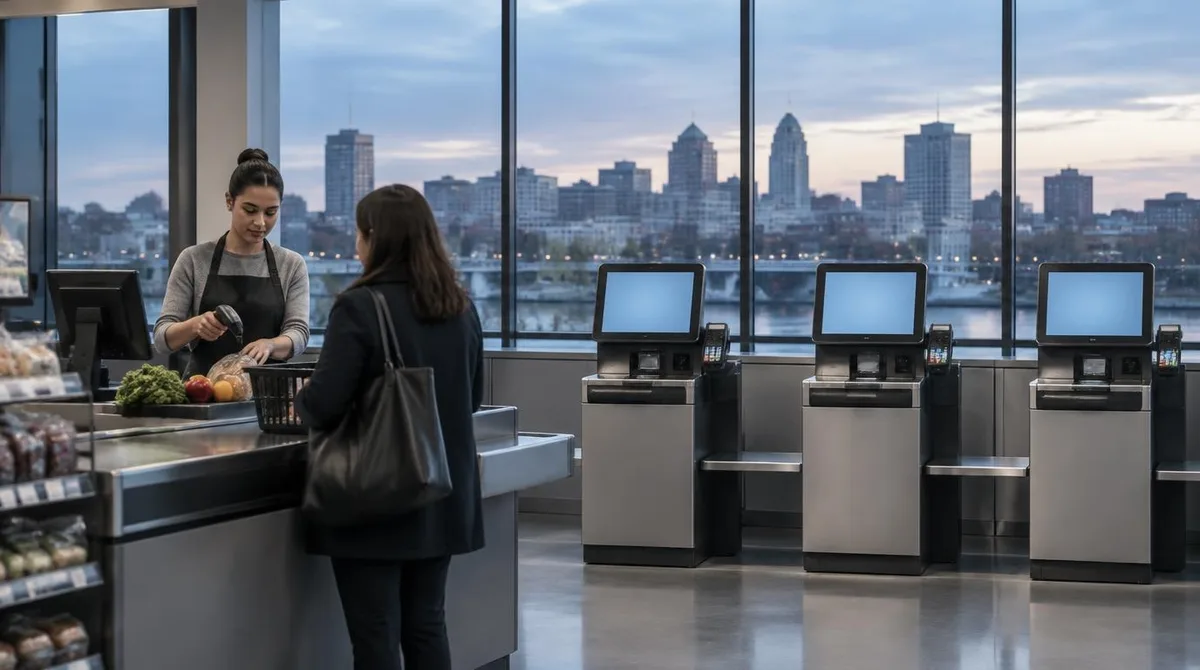
Will states start telling retailers how many self-checkout lanes they can run? Rhode Island just answered yes. A first-of-its-kind state law will govern self-checkout stations starting in 2027, and it requires at least one employee-run checkout for every three self-service stations, according to Bloomberg Law.
The measure is the first statewide mandate linking staffing levels to grocery stores' use of automation. It did not appear in a vacuum. The California cities of Costa Mesa, Long Beach and Santa Ana have already passed similar local ordinances, and the United Food and Commercial Workers International Union is urging other municipalities and states to follow. Legislation to limit retail job automation, Bloomberg Law reports, has begun to gain traction among state and local policymakers.
For anyone tracking how AI and automation get regulated in practice, this is a story about process, not just checkout lanes. The debate is moving from abstract warnings about job loss to concrete, countable rules: how many machines, how many people, on the store floor.
What does the Rhode Island law actually require?
The rule is simple enough to audit. For every three self-service checkout stations a grocery store operates, the store must staff at least one employee-run checkout. That is a ratio, not a ban. Stores can keep expanding self-checkout as long as they keep a proportional number of staffed lanes alongside it. This connects to our earlier piece, Choosing a Cybersecurity Service: What Enterprises Should Evaluate Before Signing a Contract. For related coverage, see Choosing a Cybersecurity Service: What Enterprises Should Evaluate Before Signing a Contract.
That design choice matters. A flat ban on self-checkout would be easy to challenge and hard to enforce. A ratio gives regulators something to count during an inspection and gives retailers a clear compliance target. It also keeps the law focused on grocery stores specifically, which is where the staffing-versus-automation tradeoff is most visible to shoppers.
The law takes effect in 2027, so retailers have a runway to adjust lane mixes and scheduling before it binds. Bloomberg Law's reporting, published November 27, 2026, frames it as part of a broader legislative push rather than a one-off.
Why are cities and states moving now?
Because the pattern is repeating locally first. Costa Mesa, Long Beach and Santa Ana passed their own ordinances before Rhode Island acted statewide. Backers, including the UFCW, are now urging other municipalities and states to match them, per Bloomberg Law. That sequencing — cities experiment, a state codifies, unions shop the template around — is a familiar one in retail regulation, and it usually ends with more jurisdictions adopting some version of the rule rather than fewer.
The organizing logic is explicit in the reporting: this is a fight to shield retail jobs from automation. Self-checkout is the first target because it is the most widespread and most visible example of machines replacing a staffed task in a store. Whether the same template gets applied to other automated retail functions is an open question the current laws do not answer.
What this means for retail operators
The operational cost is straightforward: labor hours. A ratio rule converts a staffing decision into a legal minimum. A store that had trimmed its staffed lanes to one or two while running a bank of self-checkout machines will need to schedule more cashier hours, or shrink its self-service footprint, to stay compliant in Rhode Island.
Compliance tracking is the less obvious burden. Stores will need to know their station counts and staffed-lane counts at any given time, which pushes checkout configuration from a store-manager preference toward something auditable at a corporate level. Retailers operating across multiple states will face a patchwork: a statewide ratio in Rhode Island, city ordinances in three California cities, and no rule at all elsewhere. Multi-jurisdiction chains rarely build systems for the loosest jurisdiction when enforcement is this easy to verify. For related coverage, see Harvard's Compass Collaborative Maps AI's Effects on Learning Across 81 Developmental Areas. This connects to our earlier piece, Harvard's Compass Collaborative Maps AI's Effects on Learning Across 81 Developmental Areas.
The broader signal for automation policy
The interesting part for the wider technology audience is what this says about how automation rules get written. Regulators are not targeting the technology itself. They are targeting the staffing decision the technology enables, and they are doing it with arithmetic a compliance officer can check. Expect that drafting pattern — ratios, headcounts, per-location mandates — to show up in debates over other forms of workplace automation, in warehouses and back offices as well as at the register.
It also reframes the vendor conversation. Checkout system suppliers selling into grocery will increasingly be selling into regulated environments where the customer's lane configuration is a legal variable. That changes procurement questions from "how fast is the scanner" to "how flexibly can we rebalance lanes when a mandate lands."
What to watch next
The near-term markers are concrete. Watch which additional states or cities adopt matching ordinances as the UFCW presses its campaign, and watch how Rhode Island's 2027 implementation goes in practice — whether grocers add staffed lanes, reduce self-service stations, or do some of both. According to Bloomberg Law, the available reporting covers the legislative landscape and the backers' push for more jurisdictions; questions about how the law plays out on store floors remain ahead of the evidence.
For now, the takeaway is directional: the first statewide mandate exists, three cities have their own versions, and the backers want more. Retail automation planning that assumed checkout staffing was purely a business decision just gained a compliance dimension, and 2027 is the deadline to plan against.